 Written by Izzy · Boston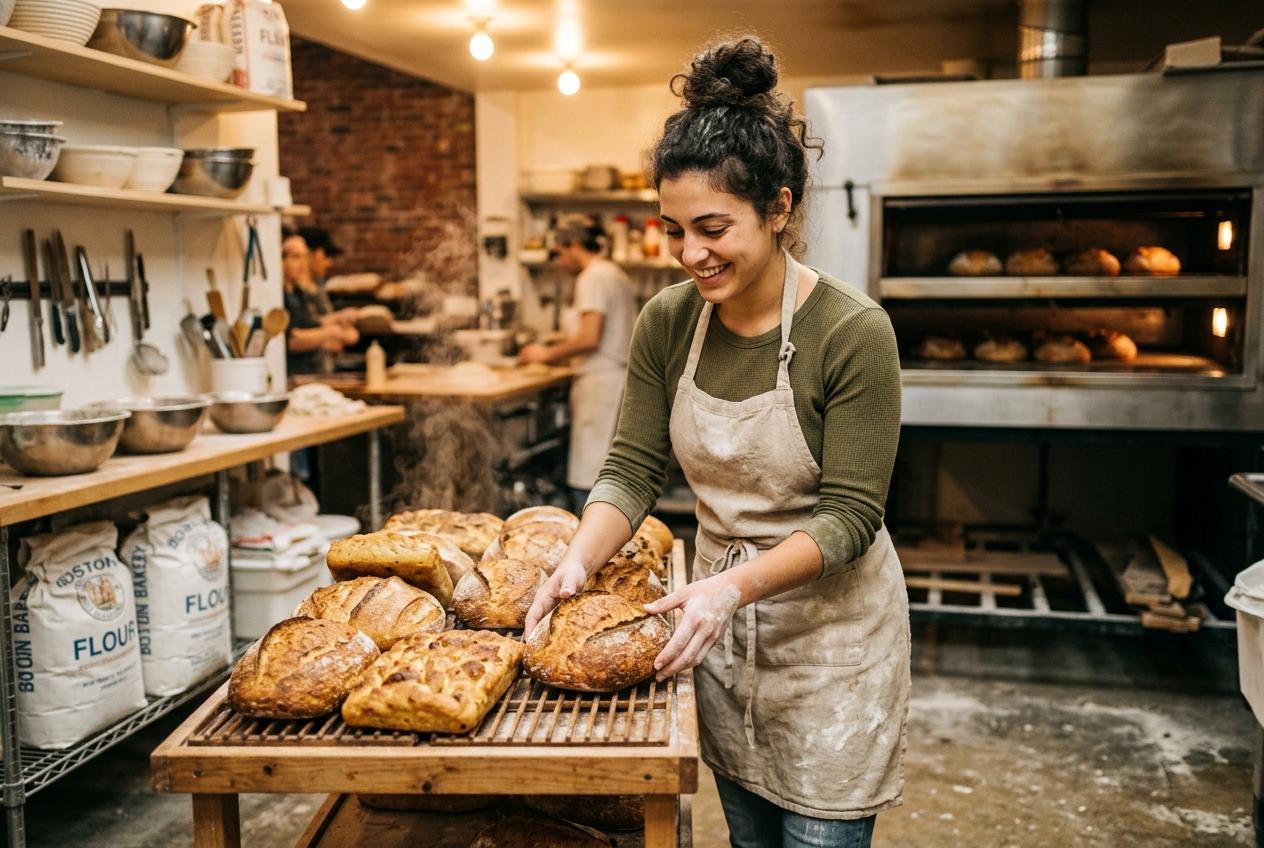
My alarm goes off at 3:45 AM. By 4:15, I am unlocking the heavy brass deadbolt of our bakery on Hanover Street. Boston in the winter at that hour is pitch black, wind sweeping off the harbor with teeth so sharp it makes your eyes water. But the minute you pull on the oven lights and the deck ovens begin to hum, the entire world shrinks to the warmth of that kitchen. Flour hangs in the air like pale gold dust under the bare bulbs. It is freezing outside, but in here, we are about to make breakfast for five hundred people.
Baking is not cooking; it is chemistry with a memory. You cannot rush fermentation. The sourdough starter bubbling in the crock on my worktable has been fed every single day since my grandmother brought it over from Calabria. When you knead dough, your hands learn things your head forgets—the exact resistance that means the gluten has developed, the silky elasticity that promises a crisp crust, the way humidity on a rainy Tuesday changes how much flour the bowl will take. It demands patience and total presence. You cannot be on your phone when you are shaping brioche.

In my family, nobody ever said 'I am deeply emotionally invested in your psychological wellbeing.' That wasn't the dialect. If my Nonna saw you looked pale, she pushed a bowl of steaming pasta e fagioli into your hands, stood over you with a block of Parmesan, and said, 'Mangia, you look like a ghost.' Food was how love became physical, edible, undeniable. To this day, if I care about you, you are going to get fed. Fresh focaccia with flaky sea salt and rosemary wrapped in butcher paper, cannoli piped thirty seconds before you take a bite, hot coffee brought to your side of the bed before you’ve opened both eyes.
The trap of being the one who feeds everyone is that people assume you are never hungry. When you are the cheerful girl who always brings a box of warm pastries, who always asks how your mother is doing, who remembers that you hate walnuts in your banana bread, people get comfortable leaning on you. They forget that holding everyone else up gets heavy. There are nights when I come home to my little apartment on Prince Street with flour still stuck in the fibers of my jeans, and the quiet feels deafening. I cook for everyone in the city, but eating dinner out of a plastic container over my own kitchen sink is how most of my Tuesdays end.
I don't need expensive rooftop dates or poetry copied out of old books. That's fine for movies, but in real life, give me someone who comes into the kitchen, takes the wooden spoon out of my hand, and says, 'Sit down. I’ll stir the sauce while you drink this.' Give me someone who notices when I am running on fumes and doesn't make me explain it. Romance to me is safety. It is coming in from a freezing Boston gale, kicking off your snow-crusted boots by the radiator, and knowing that inside these four walls, nobody has to prove anything to anybody.
So if you’ve had a week that battered you, or if you feel like you’ve been carrying the whole world by yourself, come find me. I’ll slice the warm sourdough that just came out of the oven, pour two glasses of dark wine, and let you breathe for an hour. Tell me whatever you need to get off your chest—or say nothing at all. Either way, you won't leave hungry.